Every patent begins as a record of an idea. Long before an invention becomes familiar, it exists as lines, labels, signatures, dates, and mechanical possibilities on paper.
The WALLARTES patent collection was built to rescue those moments from forgotten files and transform them into artwork with enough beauty, detail, and presence to hold a wall—and enough history to start a conversation.
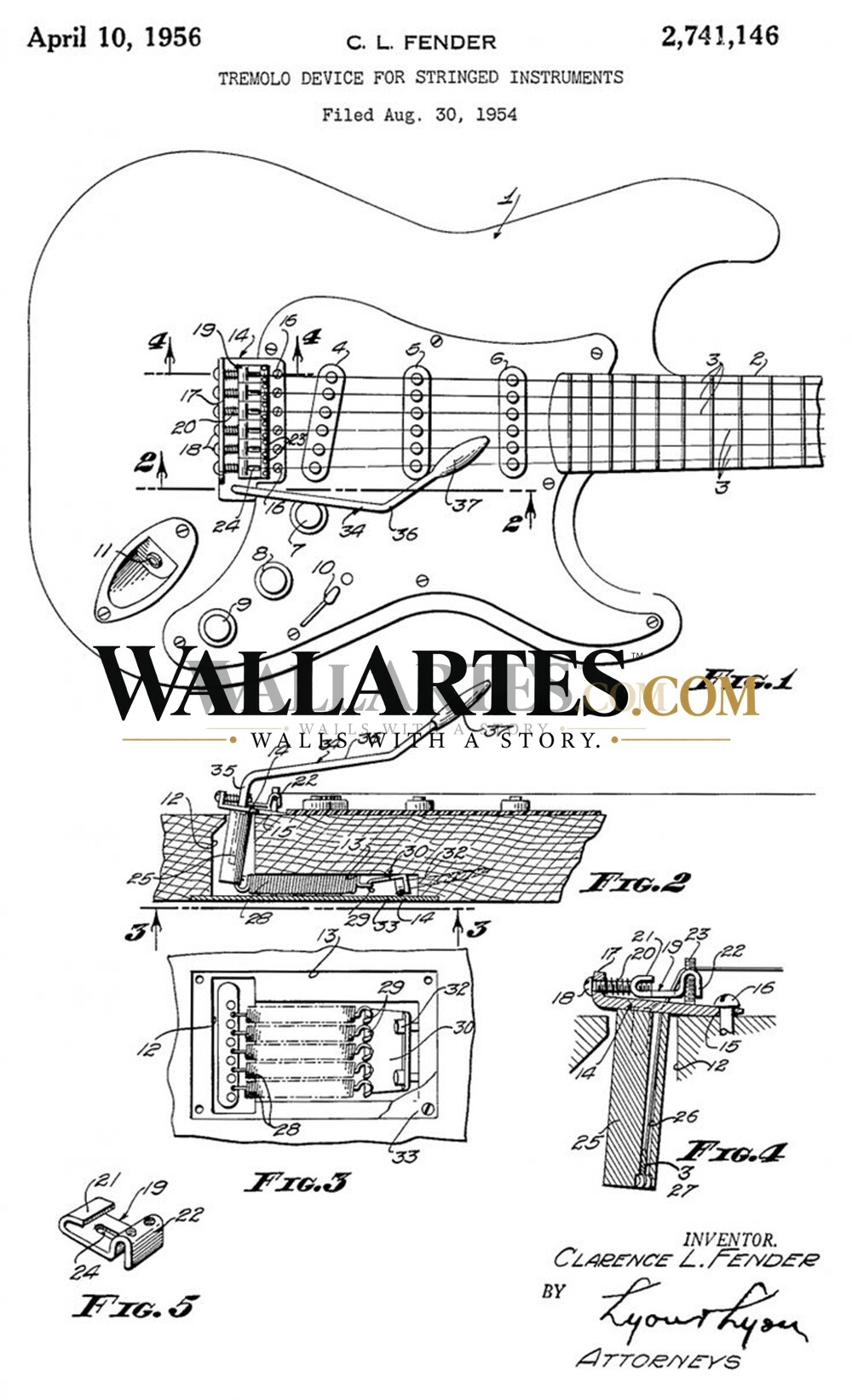
That transformation is rarely simple. Historic patent files can be faded, stained, unevenly scanned, softly focused, or compressed by generations of copying. Fine labels disappear into paper grain. Straight lines break apart. Margins lean. Backgrounds change color from one corner to another. A file that looks acceptable on a screen may fall apart when enlarged for a 36 × 48-inch print.
So every finished WALLARTES patent edition begins with care.
Building an art collection from imperfect archives
A poor archival image cannot simply be enlarged. Enlargement makes every defect larger too. Dust becomes a mark. Compression becomes a pattern. A faint patent number becomes unreadable. Before design begins, the source has to be studied, balanced, cleaned, and rebuilt as a coherent image.
The work can include correcting perspective, balancing uneven backgrounds, repairing interrupted linework, refining edges, separating the invention from paper noise, rebuilding contrast, and restoring the legibility of figure numbers, filing dates, inventor names, witness signatures, and technical notes.
Those details matter. Patent art is not generic decoration. The typography, geometry, annotations, and handwritten marks are evidence of a real invention and a real person. A restoration may look attractive and still fail if it erases the information that gives the drawing its story.
The scale of the WALLARTES patent collection
The live collection now represents:
- 267 published patent-art products across the original and dimensional collections.
- 138 original patent-art editions preserving the graphic character of archival documents.
- 129 sculpted 3D patent-art editions developed with dimensional depth, texture, highlights, and shadow.
- 2,403 live purchasable variations across the patent catalog.
- Three finishes—Parchment, Blueprint, and Grey / Black—and three sizes—18 × 24, 24 × 36, and 36 × 48 inches.
- Up to nine size-and-finish combinations for a fully developed patent product.
- A 36 × 48-inch edition covers 1,728 square inches, four times the printed area of an 18 × 24-inch edition.
- If one 36 × 48-inch print were made from every patent product, the collection would cover approximately 3,204 square feet of printed artwork.
Time is harder to reduce to a statistic, because every source presents different problems. But even using an intentionally conservative baseline of only one production hour per finished patent master, a 267-product collection represents at least 267 production hours. That baseline does not capture the additional rounds of 3D development, high-resolution preparation, watermarking, product setup, variation building, proofing, and revision that the dimensional collection requires.
Why large-format preparation changes everything
Artwork intended for large-format printing has to survive a different level of scrutiny. On a phone, a weak edge may be invisible. At four feet tall, it becomes part of the room.
Each master must be evaluated for line separation, tonal transitions, texture repetition, edge quality, contrast, and readability at output scale. Fine mechanical marks need to remain clear without becoming harsh. Paper texture should add atmosphere without swallowing labels. Shadows should create depth without turning technical information into visual clutter.
The goal is not merely a bigger image. It is a print-ready composition that still feels deliberate when viewed from inches away.
From flat documents to sculpted 3D editions
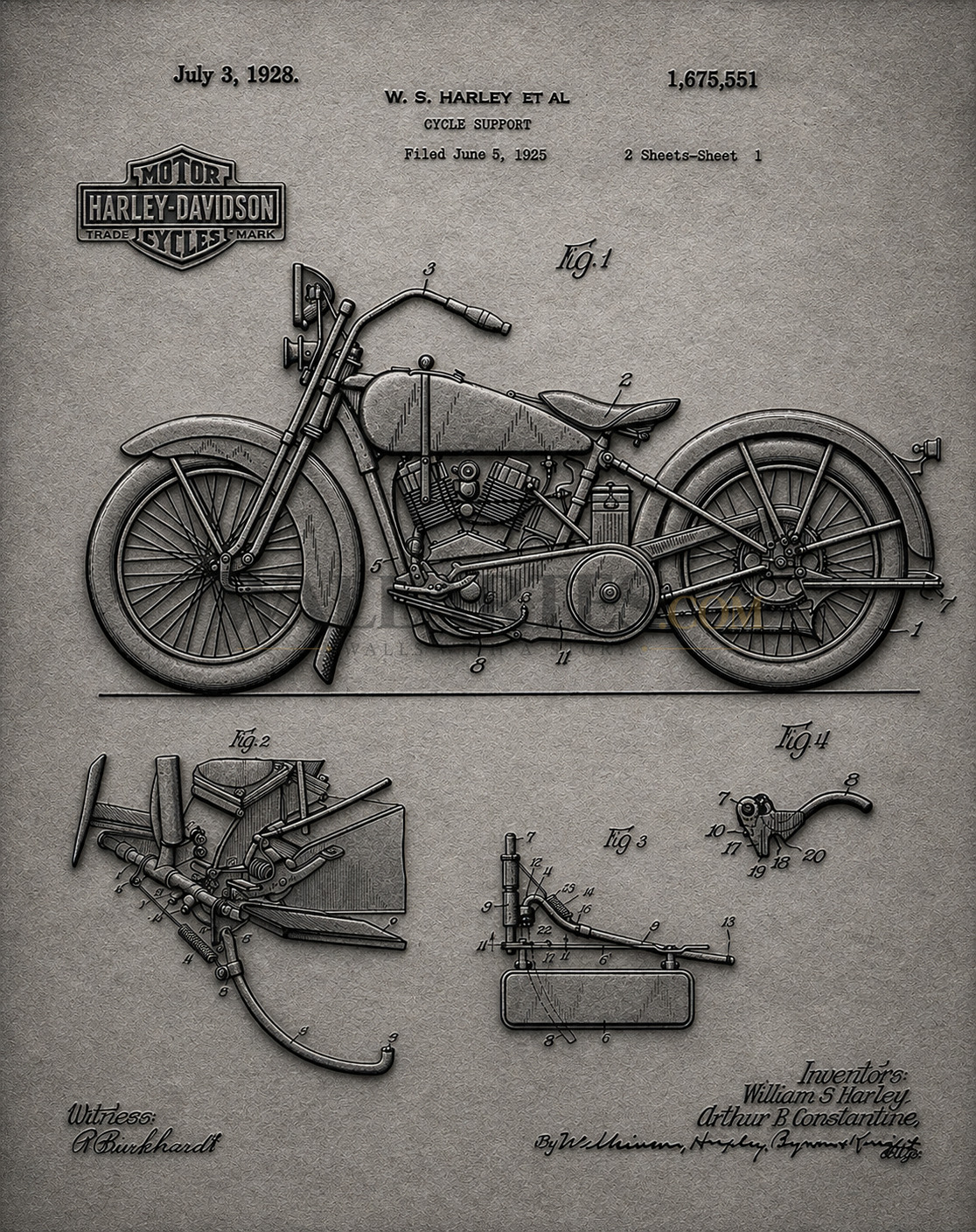
The 3D collection adds another demanding stage. Flat ink lines are interpreted as raised edges, carved channels, beveled forms, layered surfaces, and cast shadows. The lighting has to remain consistent across the entire page. The depth must feel convincing without overpowering the patent drawing.
A motorcycle wheel, a camera housing, a guitar contour, a typewriter key, and a handwritten signature cannot all be treated in exactly the same way. Each subject requires judgment about what should project, what should recede, where texture should remain quiet, and where highlights should guide the eye.
That is why the Grey / Black Harley-Davidson patent featured with this article feels less like an old filing and more like a sculpted industrial artifact—while still preserving the identity, date, layout, and story of the original patent.
Three finishes, three ways to tell the story
Parchment retains the warmth and romance of an archival document. It pairs naturally with wood, leather, libraries, offices, and traditional interiors.
Blueprint emphasizes engineering with deep navy color and pale technical detail. It feels graphic and precise in studios, workshops, modern offices, technology spaces, and contemporary rooms.
Grey / Black reduces the palette to charcoal, metal, shadow, and paper. The result is restrained and architectural—a sophisticated presentation that lets form and dimensional detail take the lead.
Artwork designed to begin conversations
People often recognize the subject before they know why it matters. Then they notice the date. They read the inventor’s name. They point out a mechanism, a signature, or a surprisingly early solution to a familiar problem.
That moment is the purpose of the collection.
WALLARTES patent pieces are visual biographies of ideas—evidence that motorcycles, cameras, musical instruments, computers, chairs, tools, and everyday objects were once uncertain, experimental, and new. Restoration allows the history to speak clearly. High-resolution preparation lets it command a large wall. Dimensional craftsmanship gives it presence. Professional printing and framing allow it to arrive ready to become part of a home, office, studio, showroom, or collection.
When someone stops and asks, “What is that?” the artwork is doing exactly what hundreds of hours of care prepared it to do.
Explore original Patent Art →
Explore sculpted 3D Patent Art →